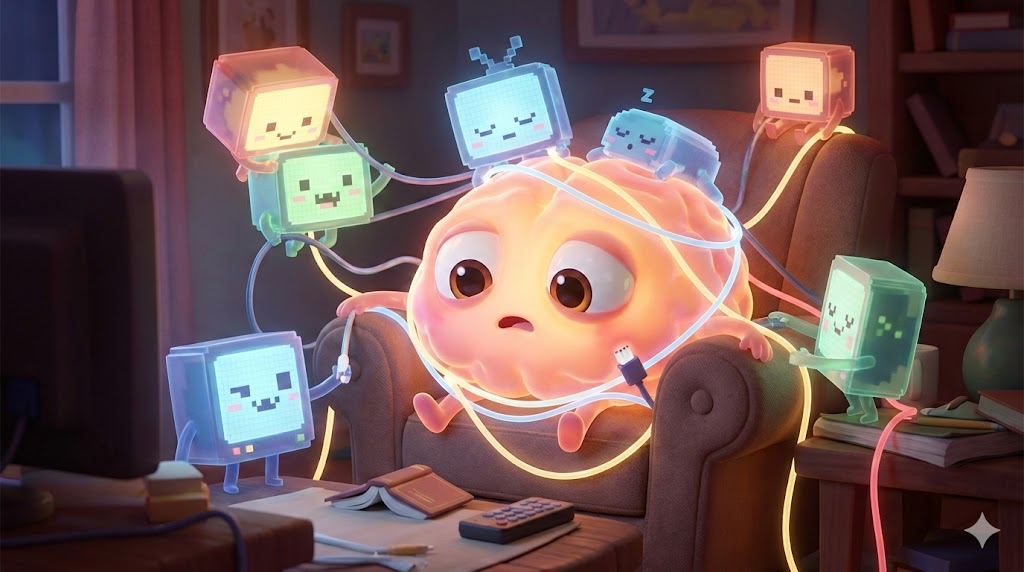
You know that feeling. You pick up your phone to check the weather, and 20 minutes later you're deep in a feed of short videos, thumb moving on autopilot. You feel foggy, guilty, and strangely tired. You haven't moved a muscle. Well, maybe your thumb.
You aren't lazy, and your willpower isn't broken. What you're experiencing is a biological response to a digital environment designed to keep you engaged.
At Monk, we believe understanding the "why" behind our habits is the first step to changing them. Let's look at what's actually happening in your brain when you scroll, and what the science says about it.
Your Brain on Dopamine 🎰
Why does it feel so hard to break phone addiction? Blame your brain's reward system. Every time you see something interesting in your feed, your brain releases a tiny hit of dopamine. Not a lot, just enough to make you want one more. Apps are engineered around this, using a technique called intermittent reinforcement. It's the same mechanism that makes slot machines addictive: you never know when the next good thing is coming, so you keep pulling the lever. Or in this case, keep swiping.
This creates a loop that completely bypasses your conscious decision-making, leading to subconscious scrolling where you consume content without truly choosing to. You're not deciding to watch 47 cooking reels at midnight. Your dopamine system is deciding for you.
The 47-Second Brain
Here's a stat that might sting: An average person now spends just 47 seconds on a single screen before switching: down from 2.5 minutes in 2004. Forty-seven seconds! That's about the time you took to finish reading this paragraph.
And every time you switch: pause work for a notification, glance at a text, peek at Instagram, your brain doesn't switch cleanly. Part of your attention stays stuck on the thing you just left. Scientists call this attention residue, and it directly tanks your cognitive capacity for whatever comes next. That foggy, "my brain has turned to mush" feeling after a day of app-hopping? That's not a vibe. It's residue piling up like browser tabs you forgot to close.
The Scroll Trap: Why You Can't Stop
Ever looked up from your phone and realized you've been scrolling for 30 minutes with no memory of choosing to? You don't even remember most of the reels you saw. Researchers call this "zombie scrolling," and honestly, that name is spot on.
The design makes it almost impossible to stop. Aza Raskin, the person who designed the Infinite Scroll, has since publicly condemned it. Research shows that it eliminates "stopping cues." Think about reading a book: you finish a chapter, you hit a natural pause, and your brain gets a moment to ask "keep going or put it down?" Infinite scroll removes that entirely. There's no bottom of the page. No chapter break. Just more content, forever.
And here's the part that really stings: a large-scale study of over 1,300 adults found that mindless scrolling doesn't just waste time, it creates "goal conflict" and guilt. The bad feeling isn't about the minutes lost. It's the realization that you lost control over the choice itself.
The Real Cost: Sleep, Mood, and Meltdowns
So you've got a dopamine loop hijacking your choices, attention residue fogging up your brain, and an infinite scroll keeping you trapped. But the damage goes even deeper than lost focus.
- Your sleep takes a hit. Research shows that excessive screen time, especially before bed, suppresses melatonin production and throws off your circadian rhythm. Translation: you scroll, you can't sleep, you wake up exhausted, and then you're even more susceptible to mindless scrolling the next day. It's a doom loop wrapped inside a doom loop.
- Your emotional regulation erodes. Scrolling stimulates the brain's reward circuits and suppresses the prefrontal cortex: the area responsible for self-regulation and decision-making. Studies have found that higher screen time is linked to increased emotional reactivity: more irritability, more frustration, a shorter fuse. You don't just lose focus; you lose the ability to manage how you feel. Ever snapped at someone for no real reason after an hour of scrolling? Yeah. That's your prefrontal cortex waving a white flag.
- Then there's screen time paralysis. You want to put the phone down. You know you should. But you physically can't seem to do it. This often overlaps with doomscrolling—compulsively consuming negative news. A 2024 study found that doomscrolling triggers existential anxiety. Your brain keeps searching for closure or safety in the information, but the algorithm is designed to never provide it. There's always one more alarming headline, one more rabbit hole.
Find Your Monk Mode
Okay, deep breath. That was a lot of bad news about… well, consuming too much bad news. But here's the thing: your brain is built to bounce back.
The fix isn't about shame, willpower, or throwing your phone into a lake (tempting as that sounds). It's about finding your Monk Mode.
Monk Mode doesn't mean you have to go live in a cave or delete Instagram forever. It's really just digital minimalism: cutting down on the noise so you can be more intentional with your time. Think of it as the sweet spot between being glued to your screen 24/7 and going full off-the-grid hermit. Here's how to start.
1. Add a Mindful Pause ⏸️
Remember how infinite scroll works by removing friction? The fix is beautifully simple: add friction back. A mindful app blocker like Monk or conscious scrolling tool introduces a tiny pause before an app opens. That split-second gap is all your prefrontal cortex needs to wake up and ask, "Do I actually want to do this right now?"
It sounds too simple to work, but it directly interrupts the dopamine loop we talked about earlier. One small pause. One moment of choice. That's all it takes to break the automatic cycle.
2. Win the First 30 Minutes ☀️
Want to know how to reduce screen time on your phone in one move? Protect your morning. When you wake up and immediately reach for your phone: notifications, news, messages, you're putting your brain in reactive mode before it's even fully online. You're layering attention residue before your day has even started.
A phone-free first 30 minutes lets your brain set its own agenda instead of reacting to everyone else's. It builds a stronger attention baseline for the whole day. Think of it like warming up before a workout—except the workout is just… being a functional human.
3. Replace, Don't Just Remove 🔄
When you try to stop procrastination, you can't just yank the phone away and leave a void. Remember the goal conflict research? Your brain is looking for a reward. If you take one away without offering a replacement, it will claw its way back to the easiest source of dopamine it knows.
So give it something better. When you feel the urge to scroll, swap it for a micro-habit: drink water, stretch, take three deep breaths, or write down one thing you want to accomplish. Small? Yes. But you're retraining a neural pathway, and that starts with tiny, consistent wins.
Your Brain Will Thank You 🧠
Here's the encouraging part the research also tells us: even one week of reduced evening screen time has been shown to shift sleep patterns and reduce symptoms of sleep loss. Your brain isn't broken—it's just been running a marathon it never signed up for.
Technology is powerful, but your brain is more adaptable. Every mindful pause, every phone-free morning, every time you choose a stretch over a scroll, you're rebuilding your baseline. The fog lifts faster than you think.
Ready to find your focus? Try Monk: Your Digital Detox Coach now.


